
Introduction
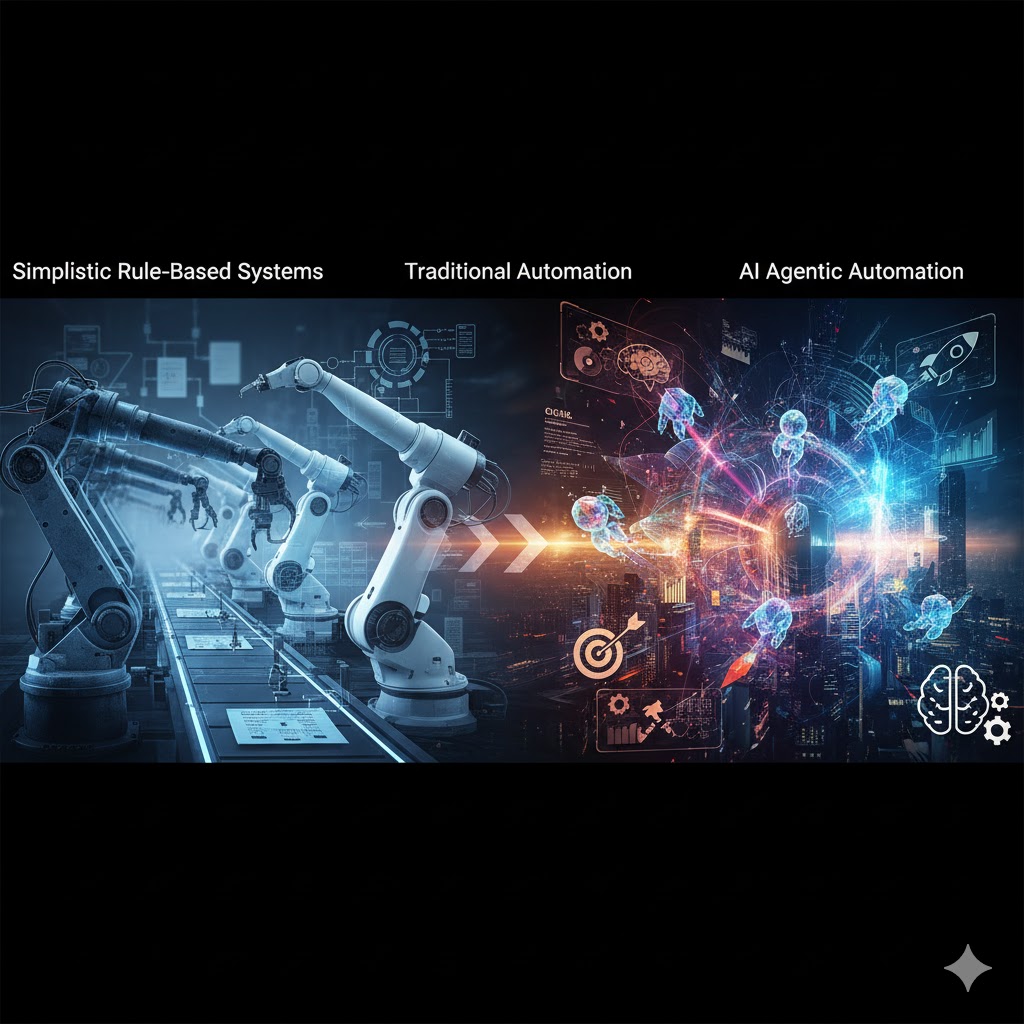
When it comes to the evolution of automation we’re looking at a progression from simplistic, rule-based systems that were told exactly what to do, to the sophisticated AI we’re working with today that can understand, learn and adapt.
Coming hotfooting out of that phase was traditional automation, which basically streamlined repetitive tasks but couldn’t think for itself. Well-known as the next stage, Agentic AI systems have revolutionized the way we do things. Capable of reasoning, recalling and processing real-time data to smash through goals and getting by with very little human intervention.
Well-known as AI Agentic Automation, these self-running systems hook up with each other to sort out the flow of work, take the temperature of the situation, and shake up processes on the fly. By injecting intelligence into the automation process, businesses can open the door to lightning-fast efficiency, razor-sharp accuracy and pure innovation. And AI Agentic Automation is not about just speeding things up. It’s about sending decision-making, self-driving work streams and a brainier, more adaptable digital workforce into the future.
What is AI Agentic Automation?
When AI and automation are combined, the result is AI Agentic Automation, a powerful system that introduces autonomous, reasoning-driven agents that can think, decide, and act independently. Perceiving goals, planning steps and then carrying out tasks with a bare minimum of human input.
AI Agentic Automation is different from Robotic Process Automation (RPA).
A rigid rule-based system, as it learns, reasons, and adjusts based on real time data, for instance, as a smart agent, would examine customer feedback, figure out what’s the best response and send instructions to tools like CRM or email software without any hard-coded steps.
By breathing life into the field of automation, AI Agentic Automation takes what was once repetitive and mundane and turns it into intelligent decision making, gives businesses a boost in productivity, accuracy and creativity and lets them move quickly in a rapidly changing market and operate basically on their own.
How AI Agentic Automation Works
You’re seeing the combination of cutting-edge AI capabilities and structured automation, all working together to generate intelligent, goal-driven workflows, when using AI Agentic Automation.
Well-known Large Language Models (LLMs) act as the brain of this system, helping to make sense of complex data, derive insights, and generate responses that understand the context of the task, be it customer communications, process automation, or general data.
Memory and Context Management is at the heart of the system’s ability to remember, retain and apply prior interactions, retaining knowledge that helps improve AI agents make better decisions as they move forward.
Planning Modules dynamically formulate decision trees that track the goals and adaptively check up on how close an agent is to achieving those goals. Autonomous planning ensures that new plans are updated, including new requirements, rules, and constraints.
In addition, Tool Integration through APIs and connectors allows AI agents to flow effortlessly with CRMs, workflow systems and other third-party apps, executing tasks and carrying out automated data fetching and triggering.
The Loopback on this system ensures it does evaluate it’s work, learns from successes or errors, and fine-tunes its processes, fostering continuous improvement.
Real-World Applications
When discussing business operations, AI Agentic Automation has the capability to update CRMs, handle emails, and generate reports all by itself. Coming from the marketing side, it can take charge of designing one-of-a-kind campaigns, creating custom content and dissecting customer insights. Customer support teams get a huge boost as their AI agents can resolve up to 80% of the regular requests that come in, all on their own.
In the financial and fintech sector, the AI agents excel at document analysis, fraudulent activity detection and client onboarding. Software developers use DevOps agents to get code written, tested and shipped out the door quickly. In the data science department, the agents tidy up data, train models and spit out reports. Wherever it goes, AI Agentic Automation knocks out drudgery, raises accuracy and gets decision-making done faster.
Benefits of AI Agentic Automation
- 24/7 Autonomous Operation
- Reduced Operational Costs
- Faster Decision-Making
- Scalability Across Departments
- Human Creativity Amplified
- Continuous Learning and Optimization
FAQ’s
What is AI Agentic Automation?
AI Agentic Automation combines intelligent AI agents with traditional automation systems to create workflows that can think, decide, and act autonomously. Unlike rule-based automation, these agents use reasoning, memory, and real-time data to plan and execute tasks, making operations more adaptive, efficient, and context-aware.
How is AI Agentic Automation different from RPA (Robotic Process Automation)?
RPA follows fixed, rule-based instructions for repetitive tasks, while AI Agentic Automation goes beyond that. It uses AI-driven reasoning and learning to handle dynamic situations, make decisions, and continuously improve—essentially transforming automation into a self-learning, goal-oriented system.
What are the main benefits of implementing AI Agentic Automation?
AI Agentic Automation boosts productivity, scalability, and decision accuracy by enabling systems to work independently. It reduces manual effort, accelerates workflows, enhances customer experiences, and helps businesses adapt quickly to changing conditions through intelligent, autonomous decision-making.
Challenges and Risks
- Data Privacy & Security Concerns
- Ethical and Accountability Issues
- Dependence on AI Decisions
- Integration Complexity
- Need for Governance and Monitoring
Tools and Platforms Enabling Agentic Automation
- LangChain, AutoGPT, BabyAGI, CrewAI
- Microsoft Copilot, ChatGPT with Actions, Gemini Agents
- Zapier + AI, Make (Integromat), n8n + LLM integration
- Custom-built enterprise agent frameworks
Future Trends
- Rise of multi-agent systems collaborating like human teams.
- Integration with IoT and Robotics for physical task automation.
- Self-learning enterprise ecosystems — where AI manages data pipelines, analytics, and optimization loops.
- Emergence of AI Governance Platforms to monitor and audit agent decisions
How Businesses Can Get Started
Practical steps:
- Identify repetitive, high-impact workflows.
- Integrate LLMs or AI APIs with existing tools.
- Start with human-in-the-loop models for trust and accuracy.
- Measure ROI and scale gradually.
- Establish governance policies for responsible automation.
Conclusion
The future of automation is no longer about machines that follow orders — it’s about agents that think, adapt, and collaborate. The question isn’t if your business will adopt AI Agentic Automation, but when.
CTA
Want to implement Agentic Automation in your business? Contact us for a consultation.